
For wealth firms and RIAs
We advise across asset classes. Our software only understands one.
Goals, model portfolios and risk profiles that draw on the whole book — not just the part your platform happens to transact.
The problem
What this looks like today.
- 01
The financial plan is a PDF describing a portfolio the client no longer holds.
- 02
Portfolio analysis stops at the classes your platform can transact.
- 03
Reviews take a day to prepare because the data lives in four places.
A day on the platform
What the work actually looks like.
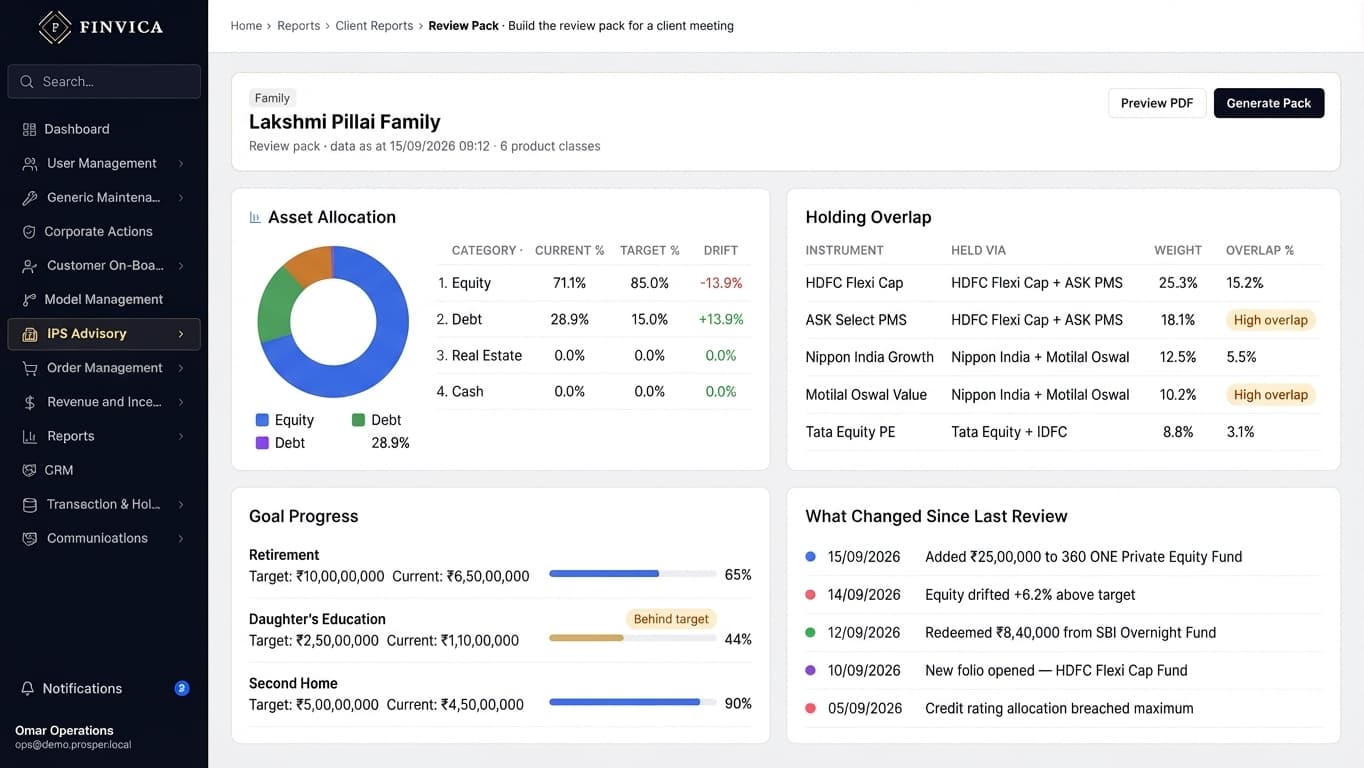
Before the review
The pack builds itself.
Holdings, allocation, overlap and goal progress across every class the client owns, current as of this morning rather than as of whenever someone last exported.
In the meeting
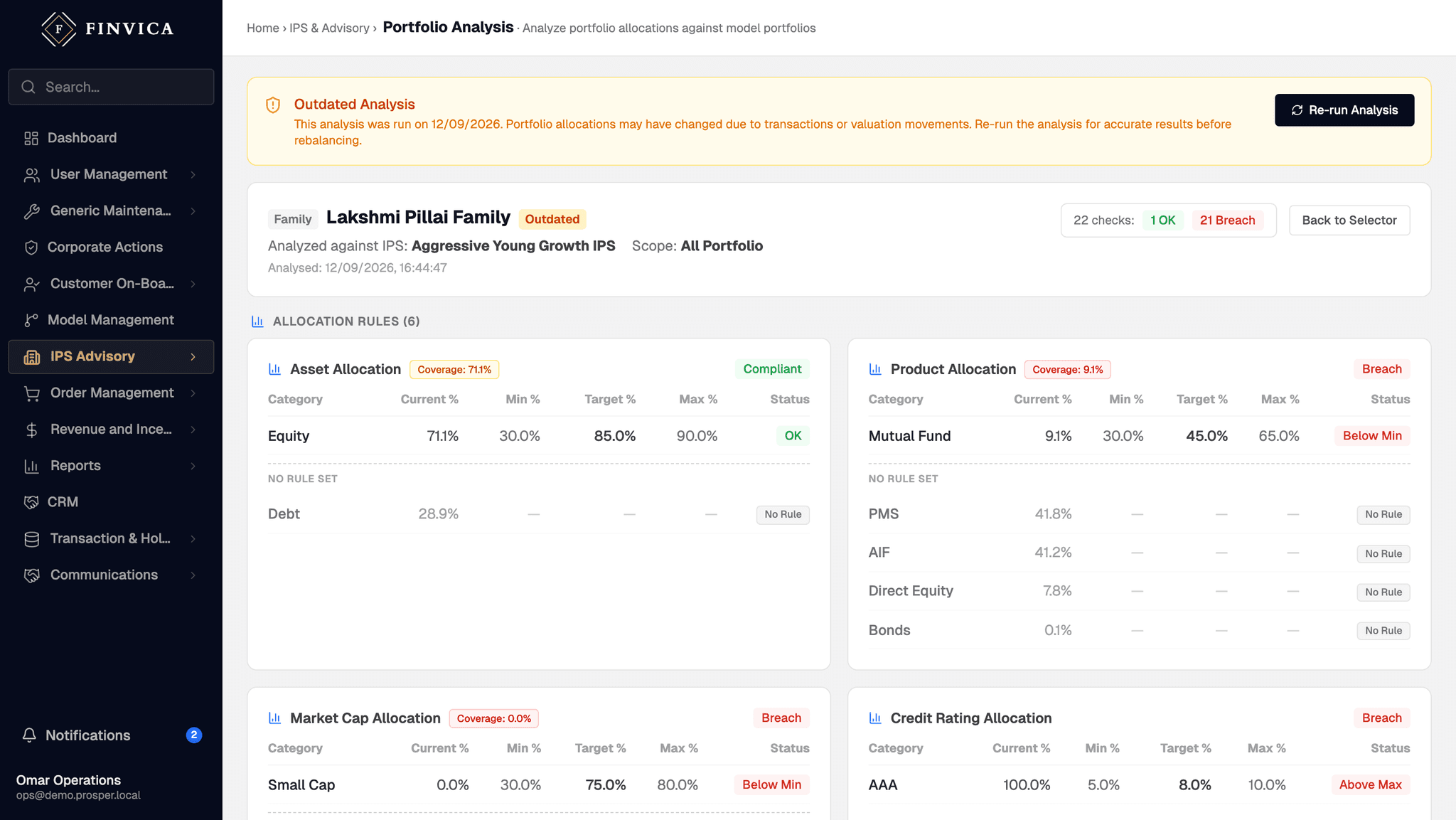
Answer the follow-up question.
Concentration by issuer, drawdown over a chosen period, what changed since last time — without promising to send it afterwards.
After
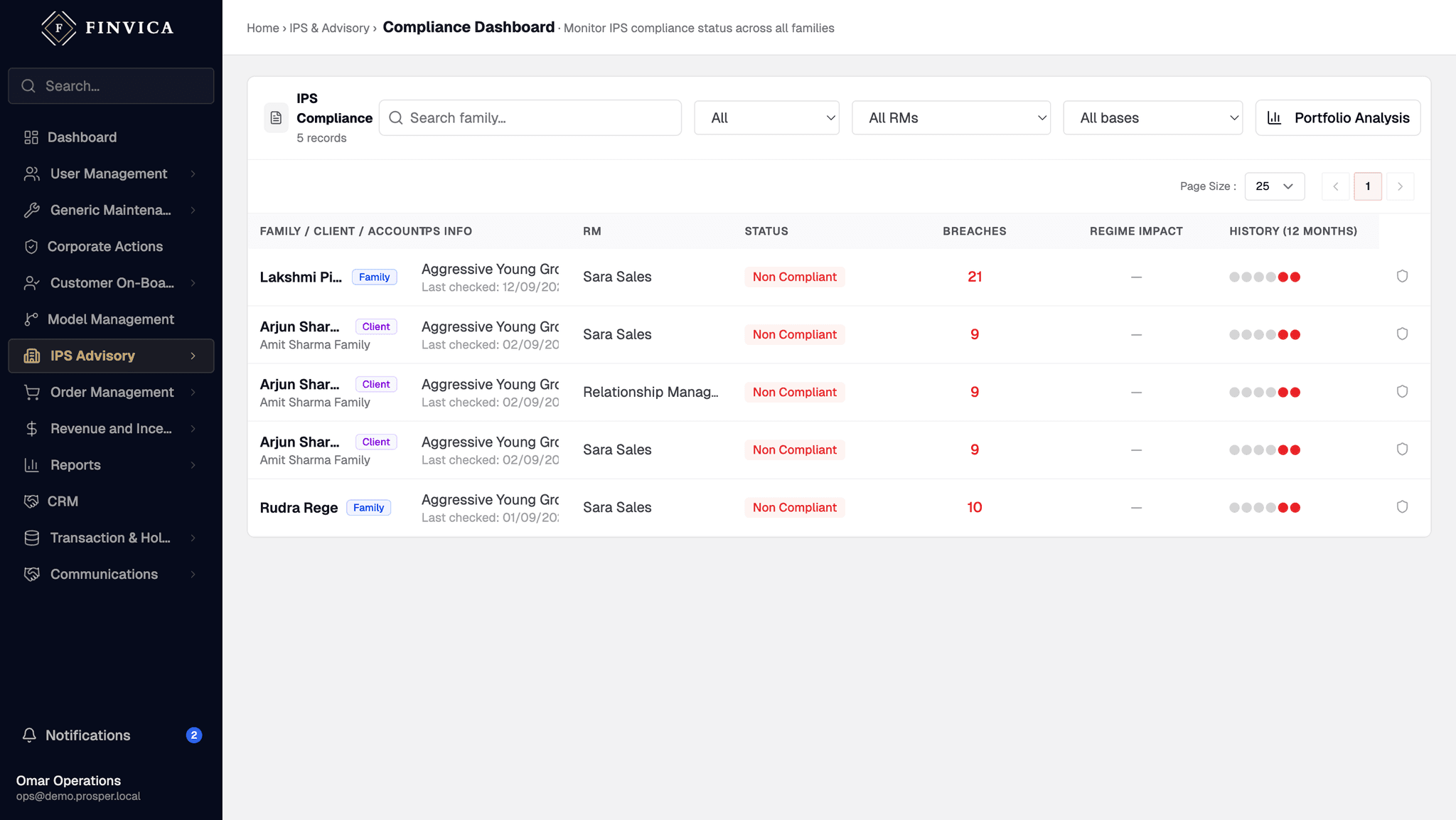
The goal keeps tracking.
Progress is computed from live positions, and drift against target allocation raises itself rather than waiting for the next review.
The modules this buyer lives in.
Serve
Answer the client before they ask.
Grow
Get paid, and see where the practice is going.
Coverage
What is supported, class by class.
| Product | Order capture | Routing | Corporate actions | Valuation basis | Reporting | Commission |
|---|---|---|---|---|---|---|
| Mutual Funds | Yes, with conditionsOnline and offline | Yes, with conditionsBSE StarMF | Yes | Yes, with conditionsUnitised — units × NAV | Yes | Yes |
| AIF | Yes, with conditionsOffline order entry, with drawdowns | Not supported | Not supported | Yes, with conditionsNon-unitised — statement value | Yes | Yes |
| PMS | Yes, with conditionsOffline order entry | Not supported | Not supported | Yes, with conditionsNon-unitised — statement value | Yes | Yes |
| Bonds | Yes, with conditionsOffline order entry | Not supported | Yes, with conditionsVia bond settlement engine | Yes, with conditionsUnitised — units × price | Yes | Yes, with conditionsRate matrix and manual entry |
| Direct Equity | Yes, with conditionsOffline order entry | Not supported | Yes | Yes, with conditionsUnitised — units × price | Yes | Yes, with conditionsNot modelled — brokerage, not commission |
| Fixed Deposits | Yes, with conditionsTransaction / holding upload | Not supported | Not supported | Yes, with conditionsNon-unitised — statement value | Yes | Yes, with conditionsRate matrix and manual entry |
| Recurring Deposits | Yes, with conditionsTransaction / holding upload | Not supported | Not supported | Yes, with conditionsNon-unitised — statement value | Yes | Yes, with conditionsRate matrix and manual entry |
| NPS | Yes, with conditionsTransaction / holding upload | Not supported | Not supported | Yes, with conditionsSet per instrument | Yes | Yes, with conditionsRate matrix and manual entry |
| Insurance | Yes, with conditionsTransaction / holding upload | Not supported | Not supported | Yes, with conditionsSet per instrument | Yes | Yes, with conditionsRate matrix and manual entry |
| Real Estate | Yes, with conditionsTransaction / holding upload | Not supported | Not supported | Yes, with conditionsSet per instrument | Yes | Yes, with conditionsRate matrix and manual entry |
Mutual Funds, AIF, PMS, Bonds and Direct Equity carry a full product specification. The other five are basic information only by design — held, valued and reported, with no product-specific fields planned. Valuation basis is set per instrument rather than per product, and defaults to unitised. Non-unitised positions report at value with zero units.
How we charge — stated plainly.
- One per-firm subscription. Everything in one licence.
- The price never scales with your AUM.
- No revenue share. No basis points. Ever.
- The number is quoted on your demo — and it holds.
- Mutual Funds
- AIF
- PMS
- Bonds
- Fixed Deposits
- Direct Equity
- NPS
- Insurance
- BSE StarMF
- CAMS
- KFintech
- AMFI
- CVL KRA
Every product class, one book
What rias and wealth firms ask.
Are goals linked to real holdings?
Yes. A goal draws on the positions assigned to it and computes progress from live valuations, so it stays true without anyone maintaining it.
Can I analyse held-away assets?
Held-away positions can be recorded and valued alongside transacted ones, so the analysis covers the client’s real picture rather than only the part you execute.
Do you support model portfolios?
Model portfolios can be applied and monitored, with drift against the model surfacing as it happens.
Does Finvica advise, or hold an RIA registration?
No to both. Finvica is technology. You hold the registration and you make the recommendations; the platform records, values and reports.