
For MFDs and IFAs
Your whole practice in one dashboard.
Every product on one book, commissions reconciled, clients served — see it running on your own data.
You are tired of
Running a modern practice on software built for one product.
- 01
Juggling BSE StarMF, a spreadsheet and WhatsApp for every switch.
- 02
Reconciling commissions by hand at month end.
- 03
Explaining a portfolio that lives in three systems.
Getting started
What day one looks like.
ARN and EUIN verified
Your registrations are checked and recorded before anything else is switched on.
Order-routing entity connected
Credentials issued for the routing entity you are registered with, tested against a live order before your book depends on it.
Existing clients imported
From a CAS file, an RTA folio master or a CSV — clients, folios, holdings and transaction history, loaded into a sandbox you inspect before it goes live.
Your product classes turned on
Only the classes you actually sell. The rest stay dormant until you need them, and turning one on later costs nothing.
First SIP booked
End to end on the live platform, with you driving, before anyone signs off.
A day on the platform
A Tuesday, on Finvica.
Morning
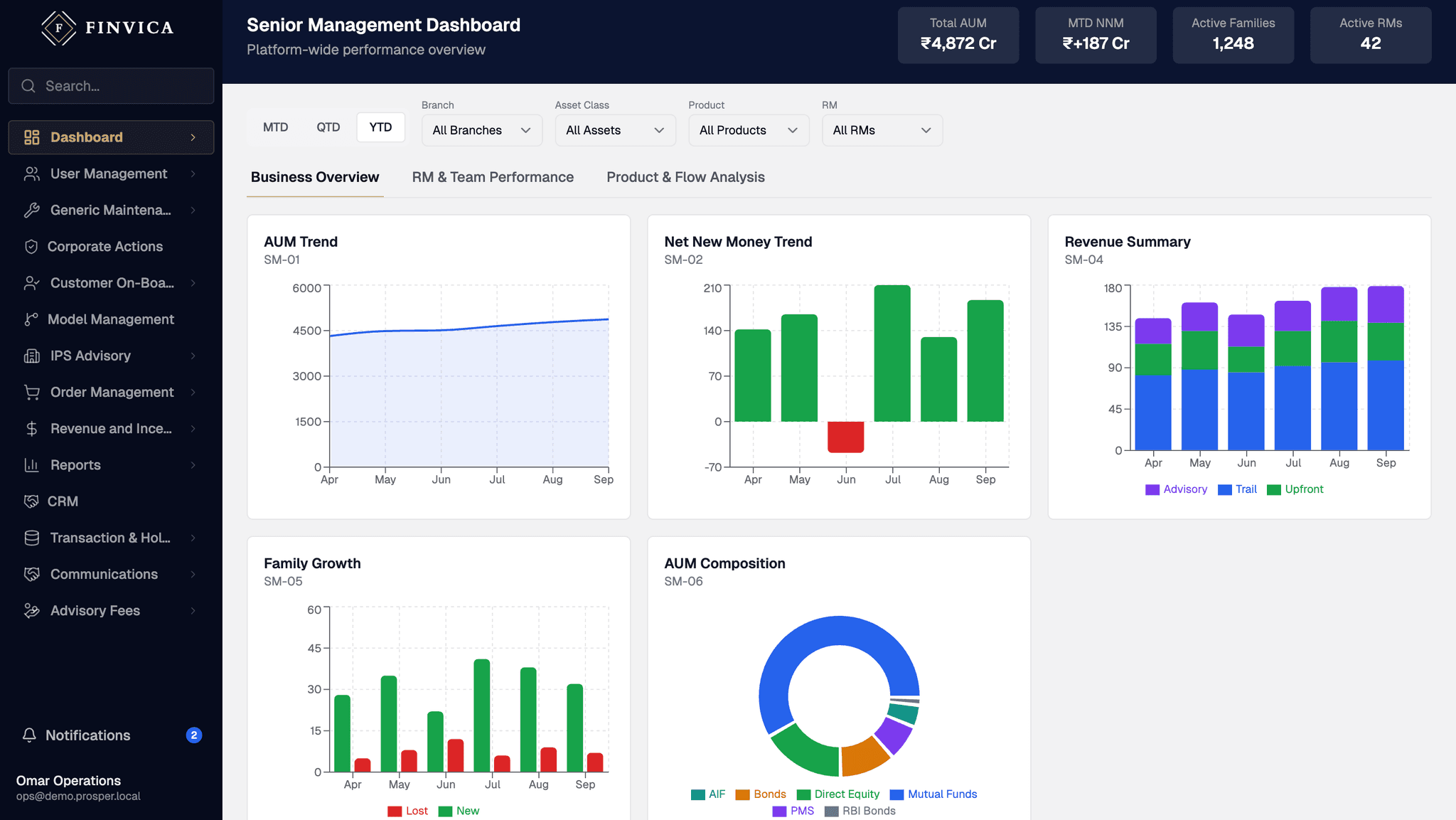
Open one screen, not four.
AUM, the SIP book, pending confirmations and today’s KYC expiries — on one dashboard, current as of this morning’s feed. You know what needs attention before the first call.
Mid-day
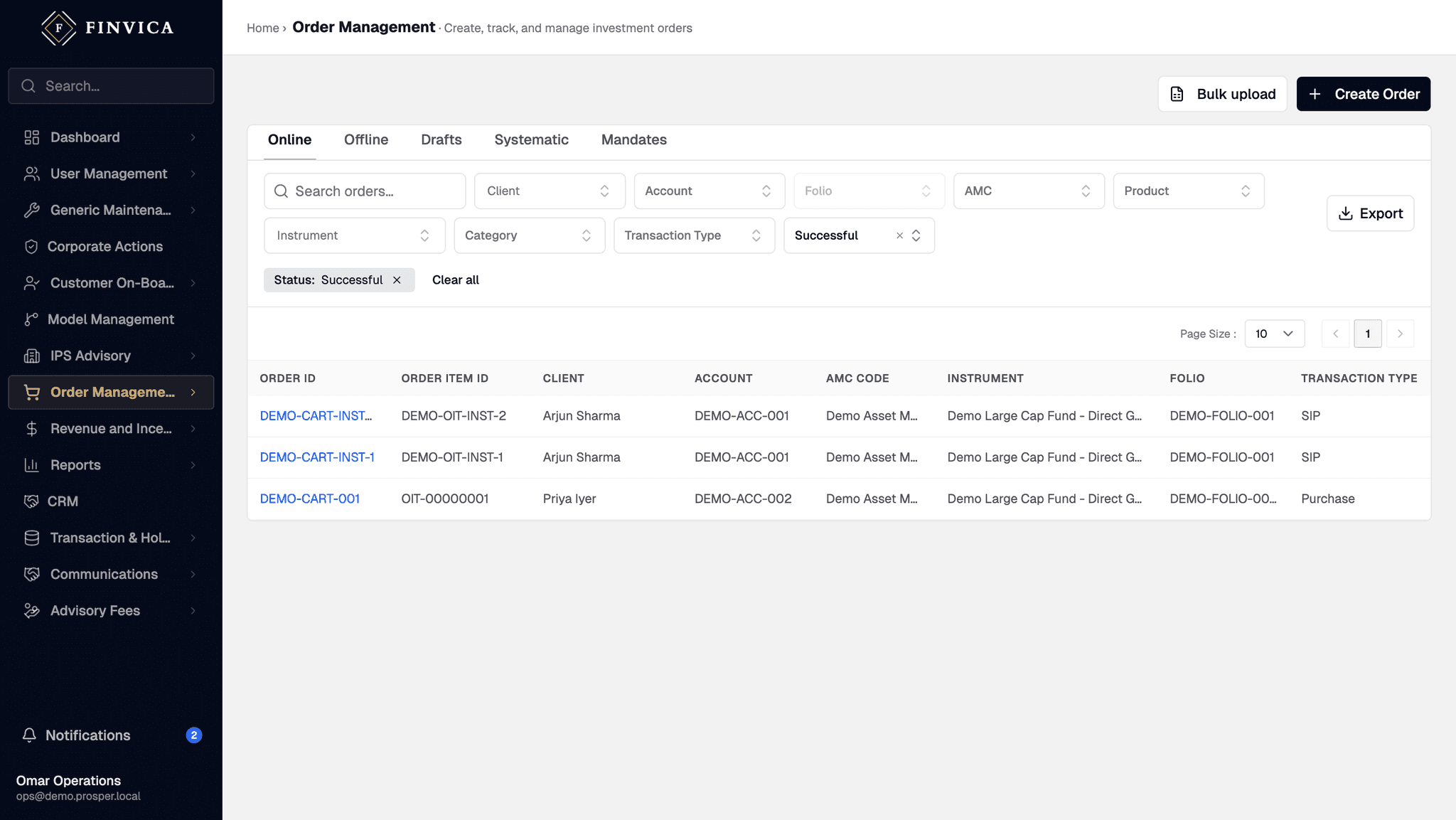
Book across four product classes without changing screens.
A SIP, a switch, a bond and a deposit go into the same basket, under the same client, against the same book. No second login, no re-keying, no spreadsheet to update afterwards.
Afternoon
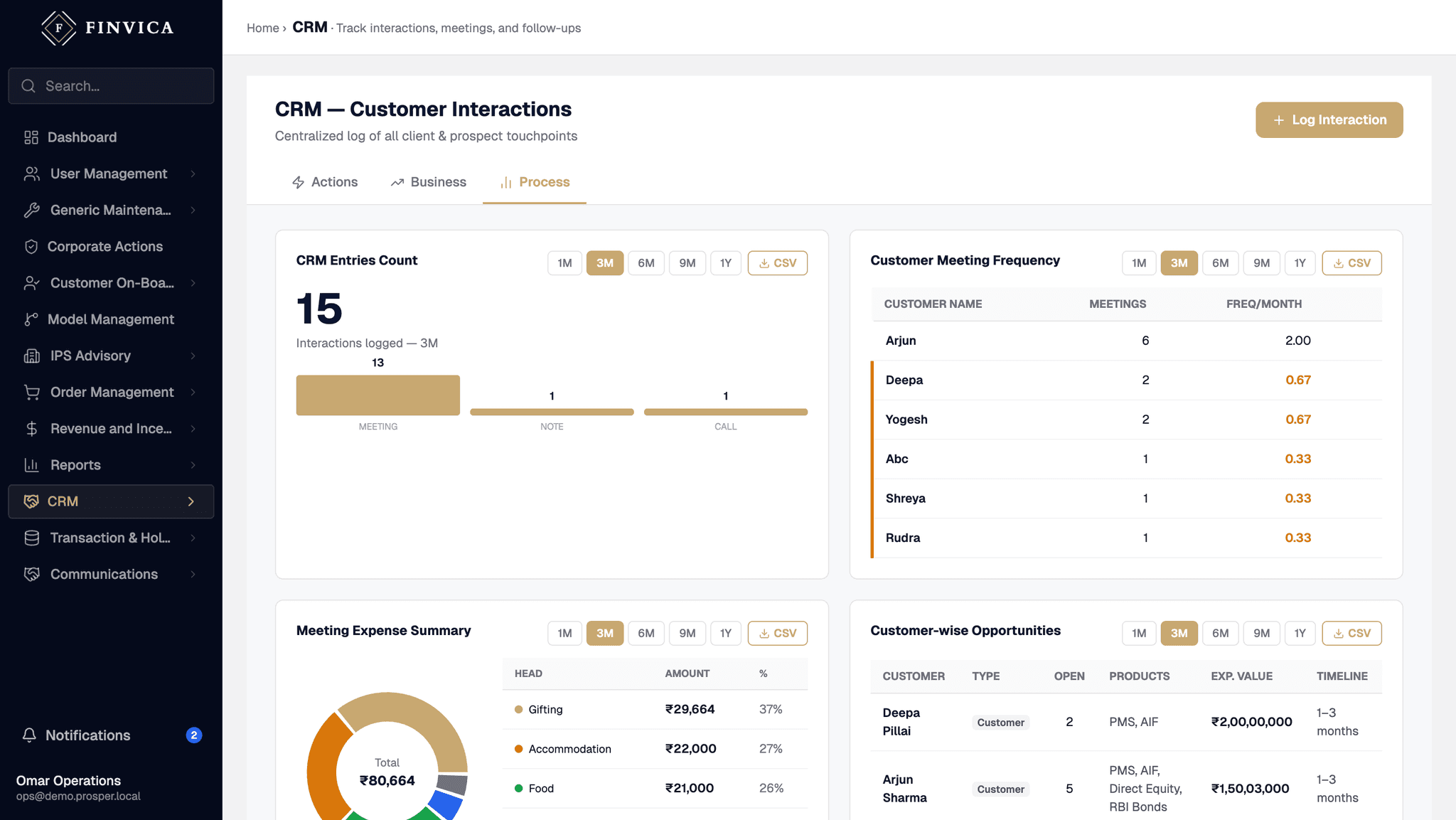
Log the call, set the follow-up, send the statement.
The client record holds the conversation as well as the portfolio, so the next person to open it knows what was said. The statement goes out from the same screen.
Month end
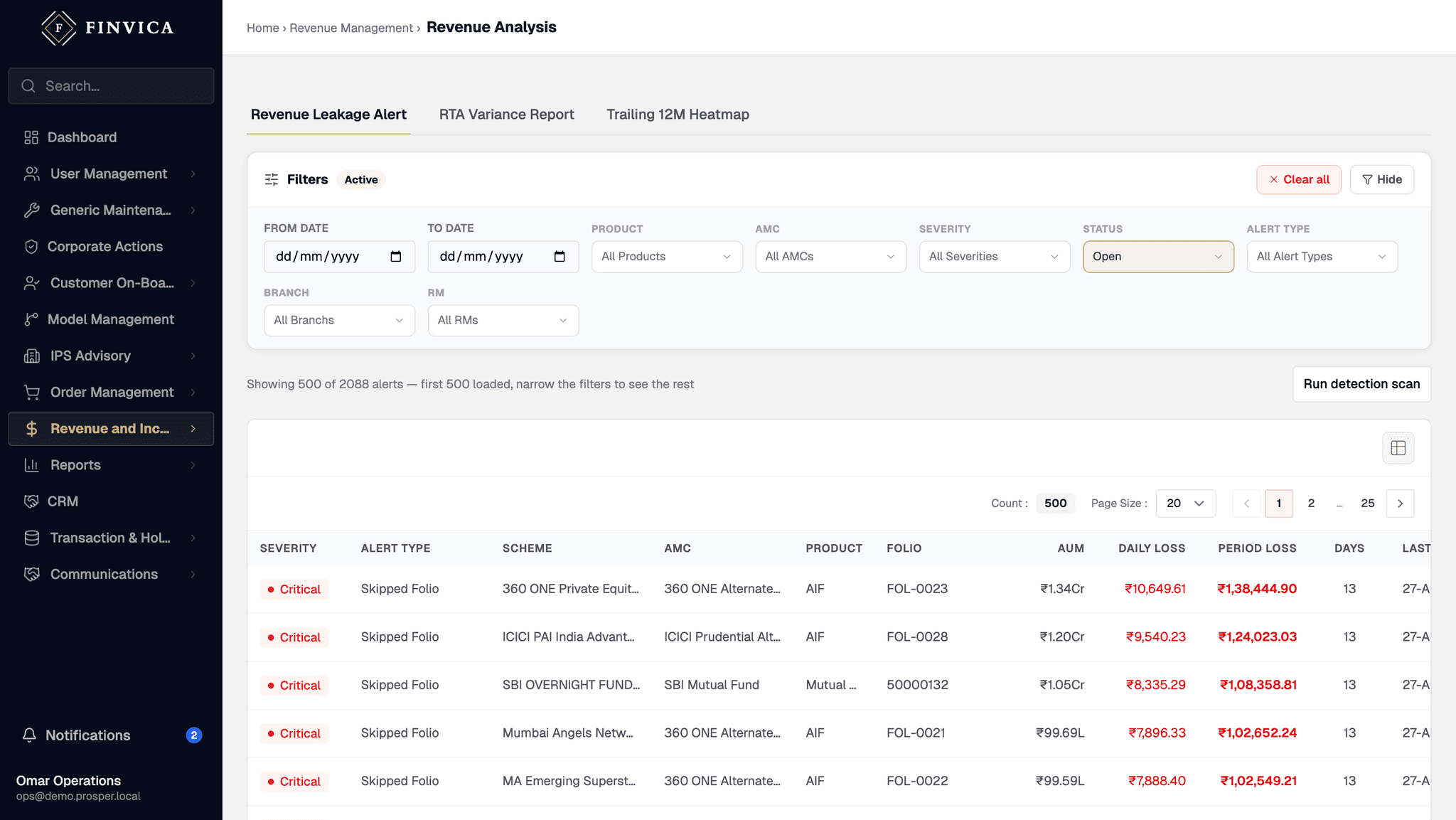
Commissions computed, reconciled and flagged.
Brokerage is computed daily and reconciled against the AMC file when it arrives. What matches settles quietly. What does not is flagged with the difference, so you chase five variances instead of auditing five hundred rows.
Everything you can put on the book.
How we charge — stated plainly.
- One per-firm subscription. Everything in one licence.
- The price never scales with your AUM.
- No revenue share. No basis points. Ever.
- The number is quoted on your demo — and it holds.
Already on another platform?
Migration is part of every onboarding engagement — your book, your history, your SIPs. The playbook is public.
- Mutual Funds
- AIF
- PMS
- Bonds
- Fixed Deposits
- Direct Equity
- NPS
- Insurance
- BSE StarMF
- CAMS
- KFintech
- AMFI
- CVL KRA
Every product class, one book
What MFDs ask us.
Do you hold an ARN?
No, and we never will. Finvica is technology. We do not run a distribution business, we do not own your client relationship, and we will never approach your clients. That is the whole reason a distributor can put their entire book on us safely.
Can I run multiple ARNs?
Yes. Multiple ARNs sit under one firm, one subscription and one consolidated book, rather than being billed or reported separately.
How is EUIN handled?
EUIN validity is enforced at order entry, so an expired EUIN is caught when the order is placed rather than when the AMC rejects it. Expiries surface on the dashboard ahead of the date.
Can I import from a CAS or a CSV?
Yes — CAS, RTA folio masters and CSV are all supported import routes, including transaction history and cost basis. The import lands in a sandbox tenant you can inspect before anything touches your live book.
What happens to my existing SIPs?
They continue. Existing registrations are mapped across during migration rather than cancelled and re-registered, so your clients are not asked to re-mandate anything.
Is the client portal white-labelled?
Yes — your brand, your subdomain, your client portal. Your clients see your practice, not ours.
How are sub-broker commissions handled?
Clients map to sub-brokers, brokerage splits by the rules you configure, and the month settles against those splits. It is part of the platform rather than an add-on.
How do I choose between BSE, NSE and MFU?
You transact under your own membership, and one routing entity is active at a time. Finvica follows whichever you are registered with, and changing it later does not require re-registering clients.
Can I export my data?
Yes. The book is yours and getting it out is a supported operation, not a negotiation. Formats and timelines are set out on the security page.
Is GST included?
No — GST is itemised separately on the invoice, alongside any exchange and RTA charges, which pass through at cost.