
For AIF and PMS distributors
When mutual funds stop being the whole business.
Commitments, drawdowns, statement-based valuation, coupon settlement and corporate actions — operationally handled, not tracked in a spreadsheet.
The problem
You have outgrown one platform and cannot justify the other.
- 01
Your mutual fund platform does five of your twelve products.
- 02
AIF commitments and drawdowns live in a spreadsheet you maintain yourself.
- 03
The enterprise suite that handles all of it quoted you a number and a nine-month timeline.
Coverage
The six classes you actually care about.
| Product | Order capture | Routing | Corporate actions | Valuation basis | Reporting | Commission |
|---|---|---|---|---|---|---|
| AIF | Yes, with conditionsOffline order entry, with drawdowns | Not supported | Not supported | Yes, with conditionsNon-unitised — statement value | Yes | Yes |
| PMS | Yes, with conditionsOffline order entry | Not supported | Not supported | Yes, with conditionsNon-unitised — statement value | Yes | Yes |
| Bonds | Yes, with conditionsOffline order entry | Not supported | Yes, with conditionsVia bond settlement engine | Yes, with conditionsUnitised — units × price | Yes | Yes, with conditionsRate matrix and manual entry |
| Direct Equity | Yes, with conditionsOffline order entry | Not supported | Yes | Yes, with conditionsUnitised — units × price | Yes | Yes, with conditionsNot modelled — brokerage, not commission |
AIF and PMS value from the provider statement rather than from units, which is why those positions report at value with zero units. Drawdowns and capital commitments are tracked on the order rather than as a corporate action. Both revenue engines exist and are named; both are less exercised than the mutual-fund one.
The alternatives operation
What running alternatives actually involves.
The capital call arrives
Recorded against the commitment, not an email folder.
A drawdown notice lands. It is recorded against the client’s commitment, the undrawn balance updates, and the client’s statement reflects the new position without anyone re-keying it.
The NAV comes in
Valuation on the right basis for the right instrument.
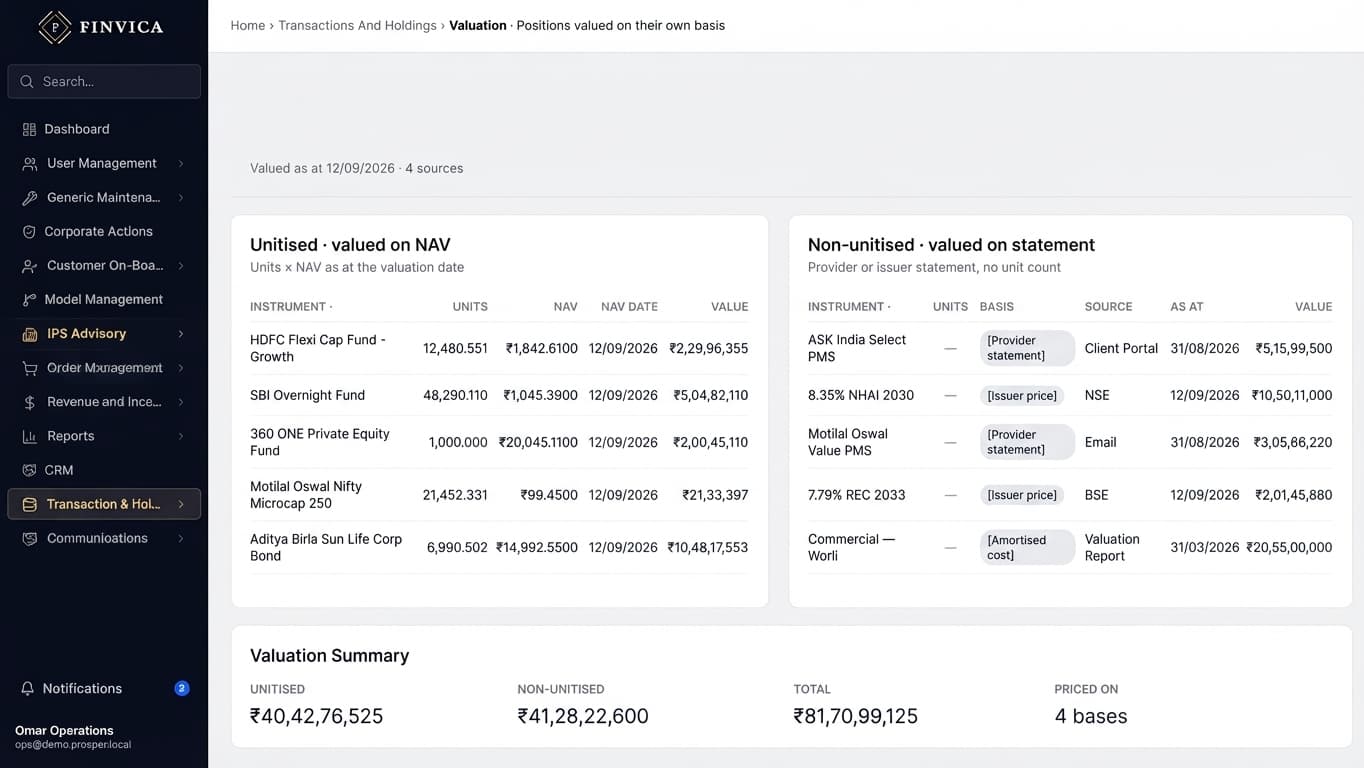
An AIF unit is priced on its NAV. A PMS position is worth what the provider statement says. A structured note is worth its payoff at this point in its life. Each is valued on its own basis rather than forced into a unit count it does not have.
The client asks
One statement, every product class.
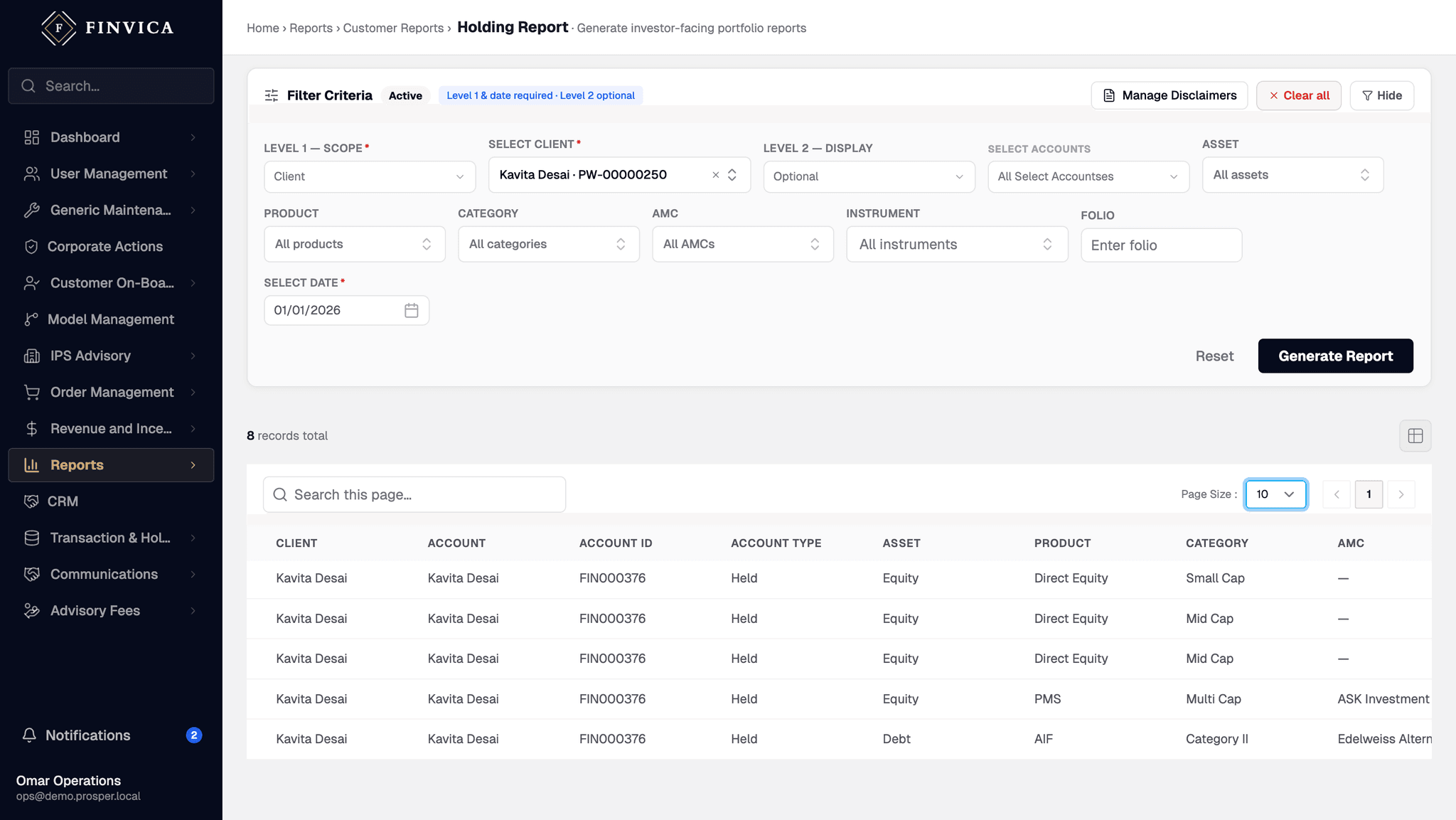
Mutual funds, AIF, PMS, bonds and the LAS drawn against them — on one statement, with one set of numbers that reconcile to each other. Not three exports stitched together the night before.
Month end
Brokerage computed across classes that pay differently.
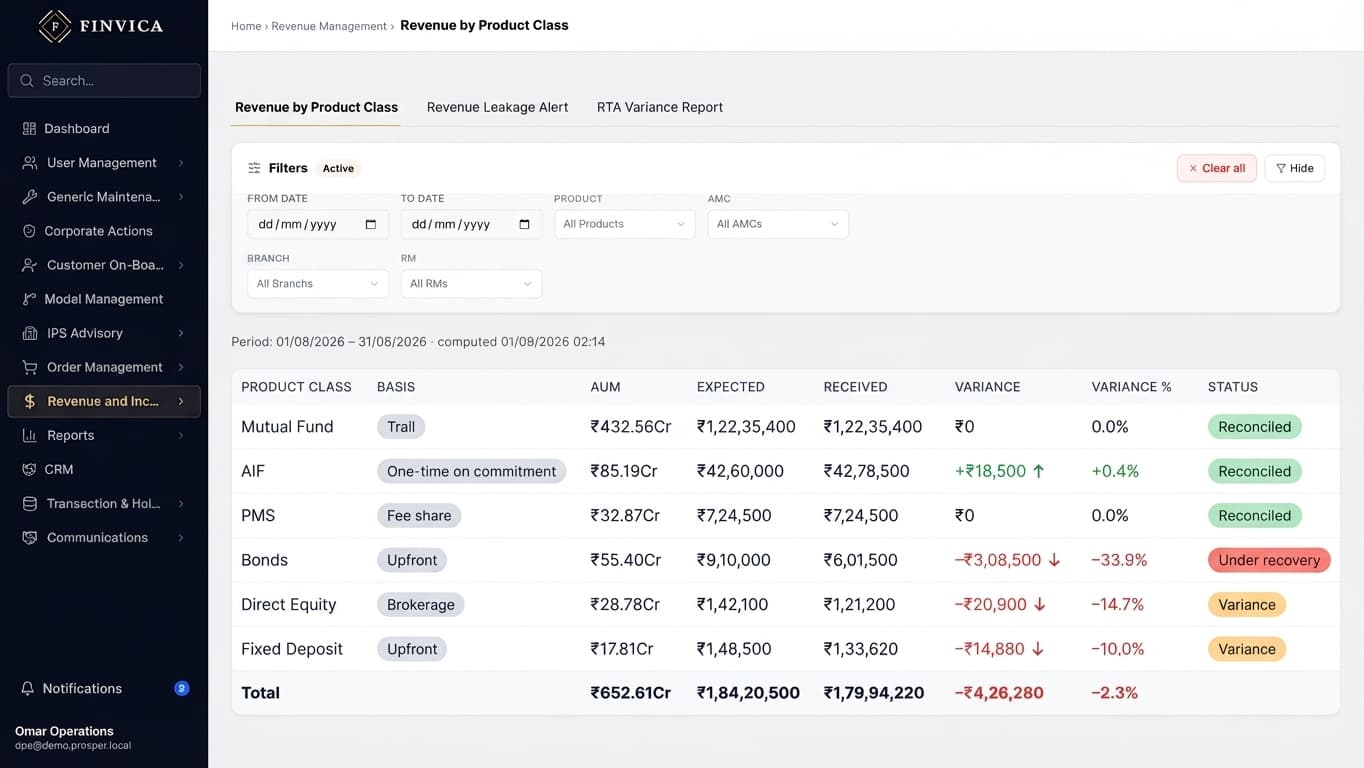
Trail on mutual funds, one-time on a commitment, a fee share on a mandate — computed on their own terms and reconciled in one place, with variances flagged rather than discovered.
The middle
Where Finvica sits.
| Finvica | Mutual-fund-first platforms | Enterprise wealth suites | |
|---|---|---|---|
| Alternatives coverage | Operationally handled — captured, valued, reported, commissioned | Holdings tracked, transactions not | Deep, across every class |
| Mutual fund depth | Full, with exchange routing | Full — it is their core | Full |
| Time to live | Weeks | Days | Months |
| Pricing model | Flat per firm, never AUM-linked | Low, often AUM-banded | Negotiated enterprise licence |
| Pricing published | Model published, number quoted | Sometimes | No |
| Who owns the client | You | Sometimes shared | You |
| Vendor also distributes | Never | Sometimes | No |
Enterprise suites are genuinely deeper at genuine bank scale, and a mutual-fund-first platform is genuinely faster to start on if mutual funds are all you sell. This table exists to show where the middle is, not to pretend the ends are bad.
No channel conflict
Finvica does not hold an ARN. It does not run a distribution business. It will never approach your clients.
Several platforms in this market are distributors who also sell software. That is a legitimate business, and it means their interests and yours are not identical: the client on their platform is, in some sense, also theirs. We are technology. We make money when you pay for the platform and in no other way — which is why we can ask you to put your entire book on us.
Intelligence
Portfolios complex enough to need explaining.
Drift detection, rebalancing with the tax consequence attached, and a reasoning chain behind every suggestion — on books that span six product classes.
What the AI actually doesMigration
Your book moves. Your clients do not notice.
Commitments, drawdown history, cost basis and mandates come across. The playbook says what does not, and why.
See the migration playbookHow we charge — stated plainly.
- One per-firm subscription. Everything in one licence.
- The price never scales with your AUM.
- No revenue share. No basis points. Ever.
- The number is quoted on your demo — and it holds.
- Mutual Funds
- AIF
- PMS
- Bonds
- Fixed Deposits
- Direct Equity
- NPS
- Insurance
- BSE StarMF
- CAMS
- KFintech
- AMFI
- CVL KRA
Every product class, one book
What alternatives distributors ask.
Do you handle AIF Category I, II and III differently?
The operational shape differs by category — commitment and drawdown mechanics matter most in closed-ended structures, while Category III behaves more like a fund. Finvica records commitments, drawdowns and the undrawn balance where they apply, and values units on NAV where the structure is unitised.
How does PMS valuation work if there is no NAV?
A PMS position is non-unitised, so it is valued from the provider’s statement rather than a published price. Finvica treats that as the valuation basis rather than approximating a unit count, which is what makes the client statement reconcile to the provider’s.
Do you compete with me for the client?
No. We do not hold an ARN, do not run a distribution business, and do not own the investor relationship. Your clients are yours, and the white-labelled portal they log into carries your brand rather than ours.
How long does it take to get a book like mine on?
Migration runs as part of the onboarding engagement, and the playbook is public — day by day, including what does not come across. Scope and timing for your specific book are agreed on the call.