
Module
Revenue and commissions — Computed daily, reconciled against the AMC file, variances flagged.
Without it
What this costs you today.
Most practices reconcile brokerage by hand, once a month, late. The work is checking hundreds of rows to find the four that disagree — and the four that disagree are the only part that matters.
What it does
Business rules, not adjectives.
Trail and upfront compute daily rather than at month end.
Computed brokerage reconciles against the AMC file when it arrives.
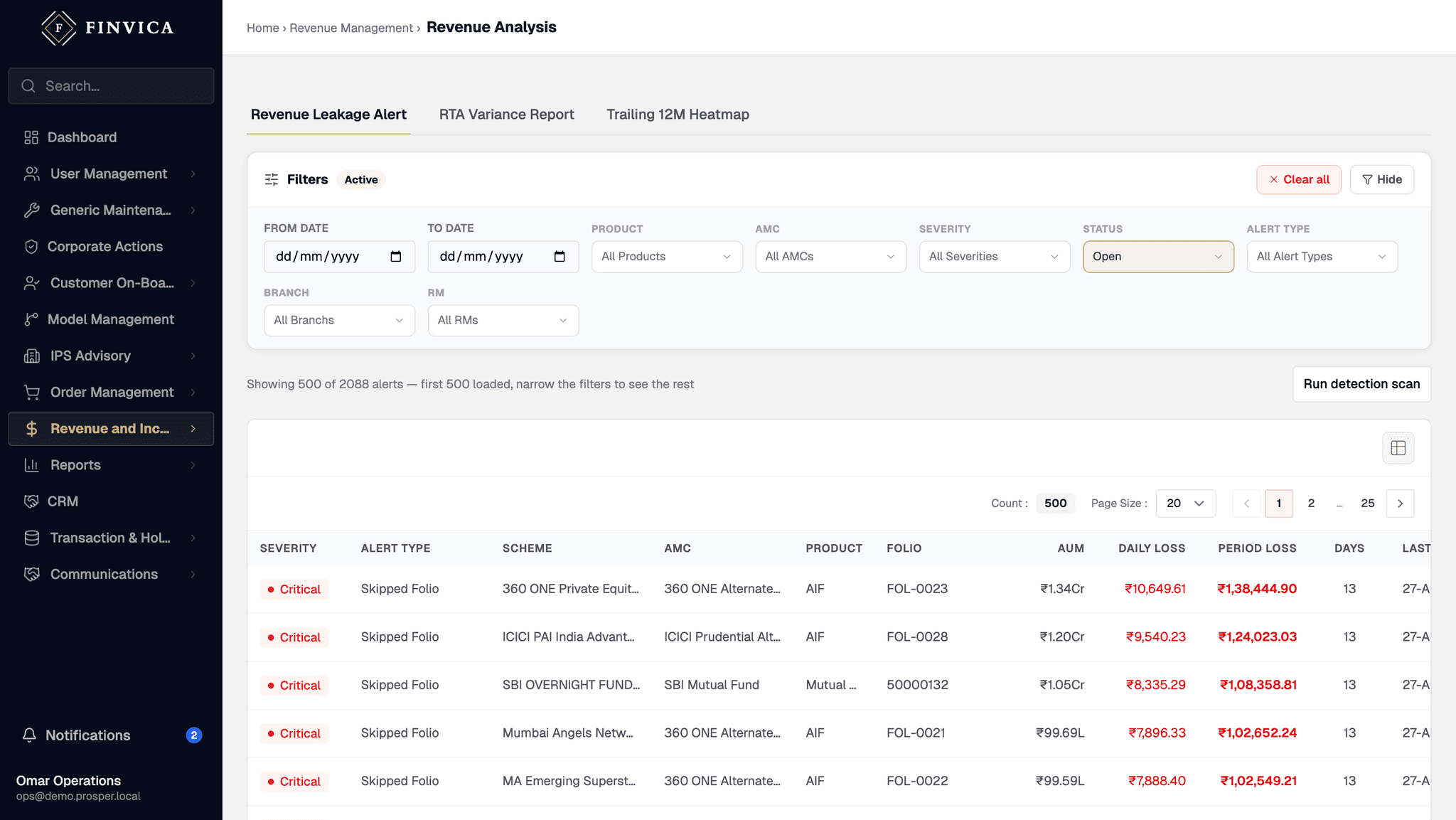
Rows that agree settle quietly; rows that disagree are flagged with the difference.
Sub-broker splits apply on the rules you configure.
Classes that pay differently compute on their own structure rather than being forced into a trail model.
Revenue is reportable by client, by class, by scheme and by sub-broker.
On screen
Revenue and commissions, as it ships.
Coverage
Which product classes this covers.
Mutual fund brokerage is fully computed and reconciled. Commission handling for other classes follows the claim register — the coverage matrix shows which are ratified.
How it works
Three or four steps, in order.
Brokerage computes
Daily, from positions and the applicable rate structure.
The AMC file arrives
And is matched against what was computed.
Variances surface
You chase five differences instead of auditing five hundred rows.
Splits settle
Sub-broker shares apply and the month closes.
Questions about revenue and commissions.
Does it reconcile against the AMC file automatically?
Yes. Computed brokerage is matched against the received file and the differences are flagged — that difference list is the module’s actual output.
How are sub-broker splits handled?
On the rules you configure, applied when brokerage computes rather than as a separate month-end exercise.