
Platform
One platform, end to end.
From distributor registration to commission reconciliation, every step of a wealth practice runs in one system, on one data model, with one reconciliation.
How the work moves
Seven stages. No export between any two of them.
01
Onboard
PAN in, KYC checked, account open.
02
Order
Every product class in one basket.
03
Execute
Routed to the exchange or captured offline.
04
Settle
The RTA feed lands and the book updates itself.
05
Value
What every client owns, priced this morning.
06
Report
Statements out on schedule, dashboards current.
07
Earn
Computed daily, reconciled against the AMC file.
One data model underneath. No stage exports to reach the next.
Every product class on the same book.
Sixteen modules, in the order a practice uses them.
Set up
Get the firm, its people and its clients onto the system.
Transact
Move money and keep the book true.
Serve
Answer the client before they ask.
Grow
Get paid, and see where the practice is going.
- Computed daily, reconciled against the AMC file, variances flagged.Revenue and commissions
- Overlap, concentration and drawdown — before the client asks.Portfolio analytics
- The maths, in front of the client, saved to their file.Tools and calculators
- Build your own flow on top of ours.APIs and integrations
The data model
Group → Family → Client → Account. Four levels, one hierarchy, every module.
Consolidation happens at every level because the structure is in the data model, so the family view is not assembled — it exists.
One treeRead by all sixteen modules. Written once.
Group
A holding structure, a corporate, an office
Family
Related individuals reported together
Client
The person or entity who owns the money
Account
A folio, a demat, a PMS mandate
Connected where it matters.
Seven categories
Order routing
Orders leave the platform and reach the exchange.
RTA feeds
Folio masters and transaction files land and reconcile.
KYC and KRA
Identity checked inside onboarding, not beside it.
Market data
NAVs, prices and corporate action announcements.
Payments and mandates
Collection and recurring authorisation.
Identity
Your existing sign-in, not another password.
Open API
REST endpoints and webhooks for your own flows.
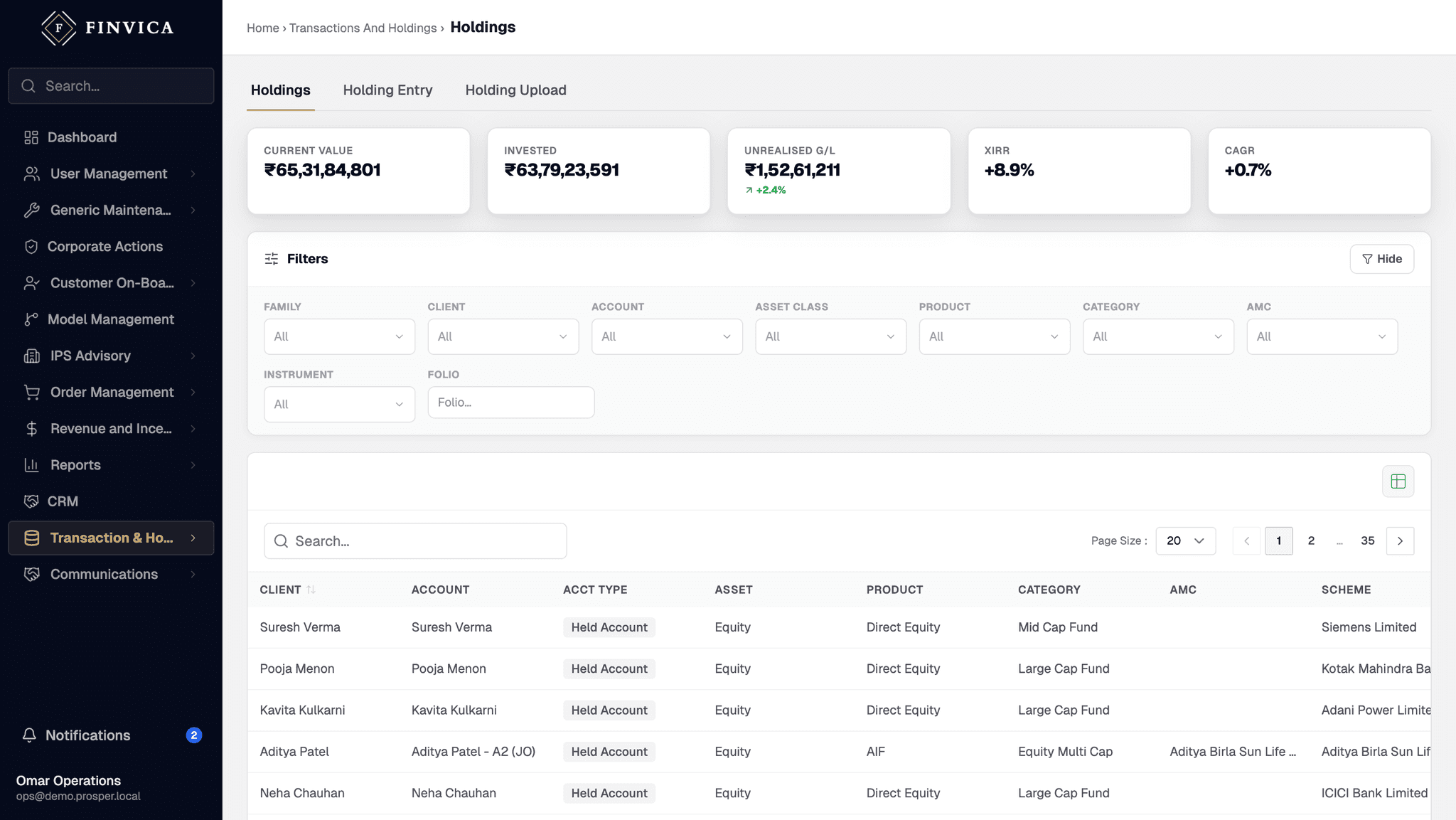
On screen
One book. Every class. One set of numbers.
Deployment
SaaS, your cloud, or your data centre.
Run it as a service, in your own cloud account, or inside your data centre. The deployment choice does not change the platform.
Enterprise and white-labelIntelligence
AI that names the portfolio and the reason.
An analytics layer that surfaces and explains — drift, next best action, rebalancing, with the reasoning attached. It does not advise.
What the AI actually doesQuestions people ask first.
Is this one product or several?
One. Every module reads and writes the same book — the same clients, the same holdings, the same transactions. There is no export step between onboarding and orders, or between valuation and commissions, because there is nothing to export to.
Can I use it for only mutual funds?
Yes. Mutual funds work on their own, and the other product classes sit dormant until you put something on them. Nothing about the platform assumes you sell beyond mutual funds — it assumes you might, one day, without changing systems.
Which order-routing entity do I need?
You transact under your own registration, and one routing entity is active at a time. You can change which one later without re-registering your clients.
Do you hold an ARN?
No, and we never will. Finvica is technology. We do not run a distribution business, we do not own the investor relationship, and we will never approach your clients. Distributors on the platform transact under their own ARN or RIA registration.