
Module
Holdings and valuation — What every client owns, priced this morning.
Without it
What this costs you today.
A client asks what they are worth. Without one book, the answer requires three logins, a spreadsheet and an hour — and the number you eventually give them is already a day old.
What it does
Business rules, not adjectives.
Every class the client holds, in one position view.
Unitised holdings value at units × price; non-unitised holdings value on their own correct basis.
A PMS position values from the provider statement rather than an approximation.
Cost basis is carried through migrations and corporate actions, which is what makes gains reporting correct.
Held-away positions are recorded and valued alongside transacted ones.
Valuation history is retained, so a position can be valued as at a past date.
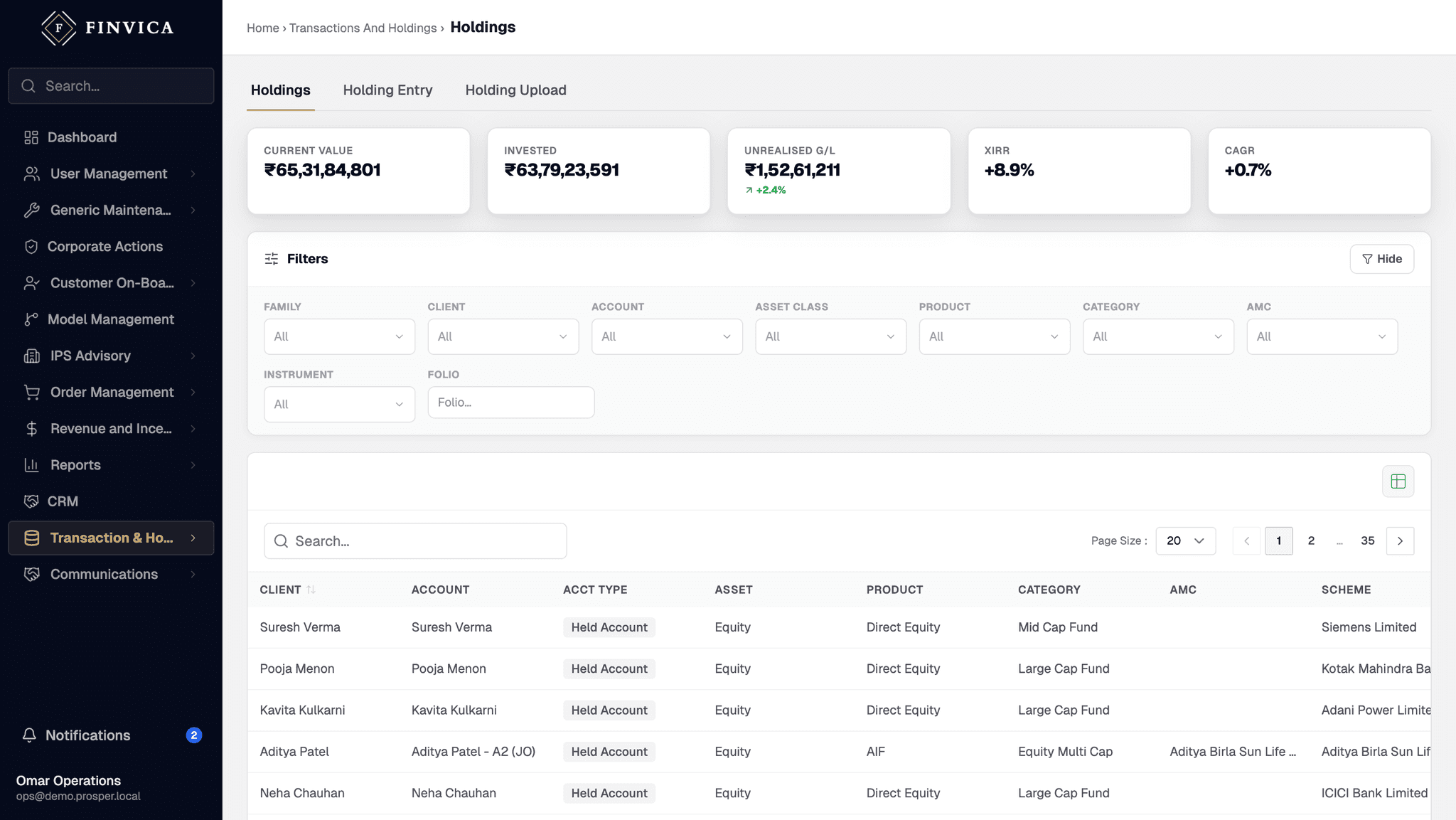
On screen
Holdings and valuation, as it ships.
Coverage
Which product classes this covers.
Every product class on the book. The valuation basis differs by class and is stated per class in the coverage matrix.
How it works
Three or four steps, in order.
Positions assemble
From processed feeds, captured holdings and provider statements.
Each values on its own basis
Units × NAV, accrual, provider statement or payoff, as the instrument requires.
The client view consolidates
Across classes, across accounts, up the four-level hierarchy.
Questions about holdings and valuation.
How current are valuations?
Positions value from the most recent price or statement received. Mutual funds price daily from the NAV feed.
Can I value a portfolio as at a past date?
Yes — valuation history is retained rather than overwritten.