
Module
Order management — Every order, every product class, one basket.
Without it
What this costs you today.
Without it, a switch in a mutual fund and a top-up in a PMS mandate are two different systems and two different days. The client asked for both in the same phone call, and your record of that call is in a third place.
What it does
Business rules, not adjectives.
Orders across every product class go into one basket under one client.
An expired EUIN blocks the order at entry rather than being rejected by the AMC two days later.
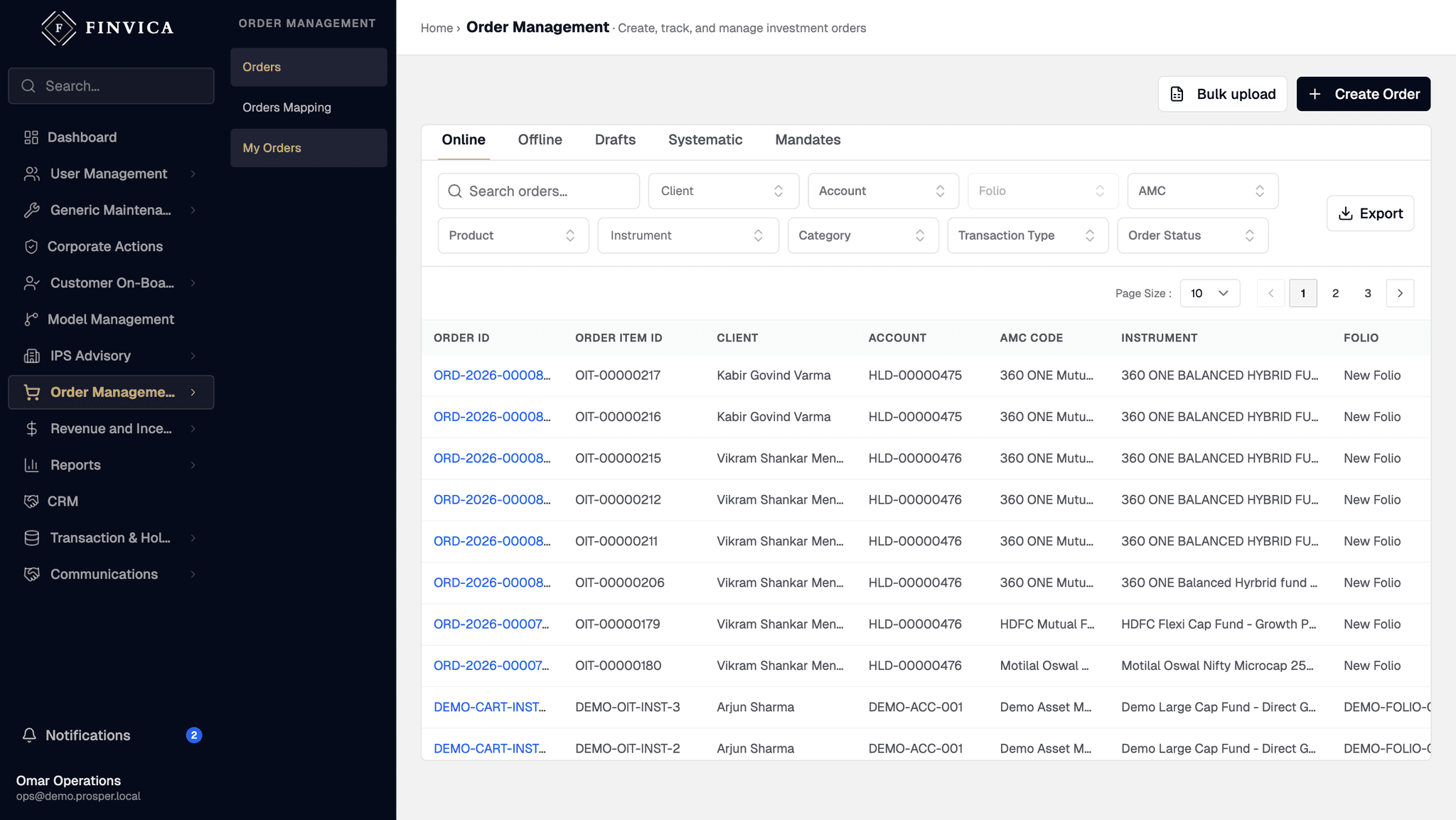
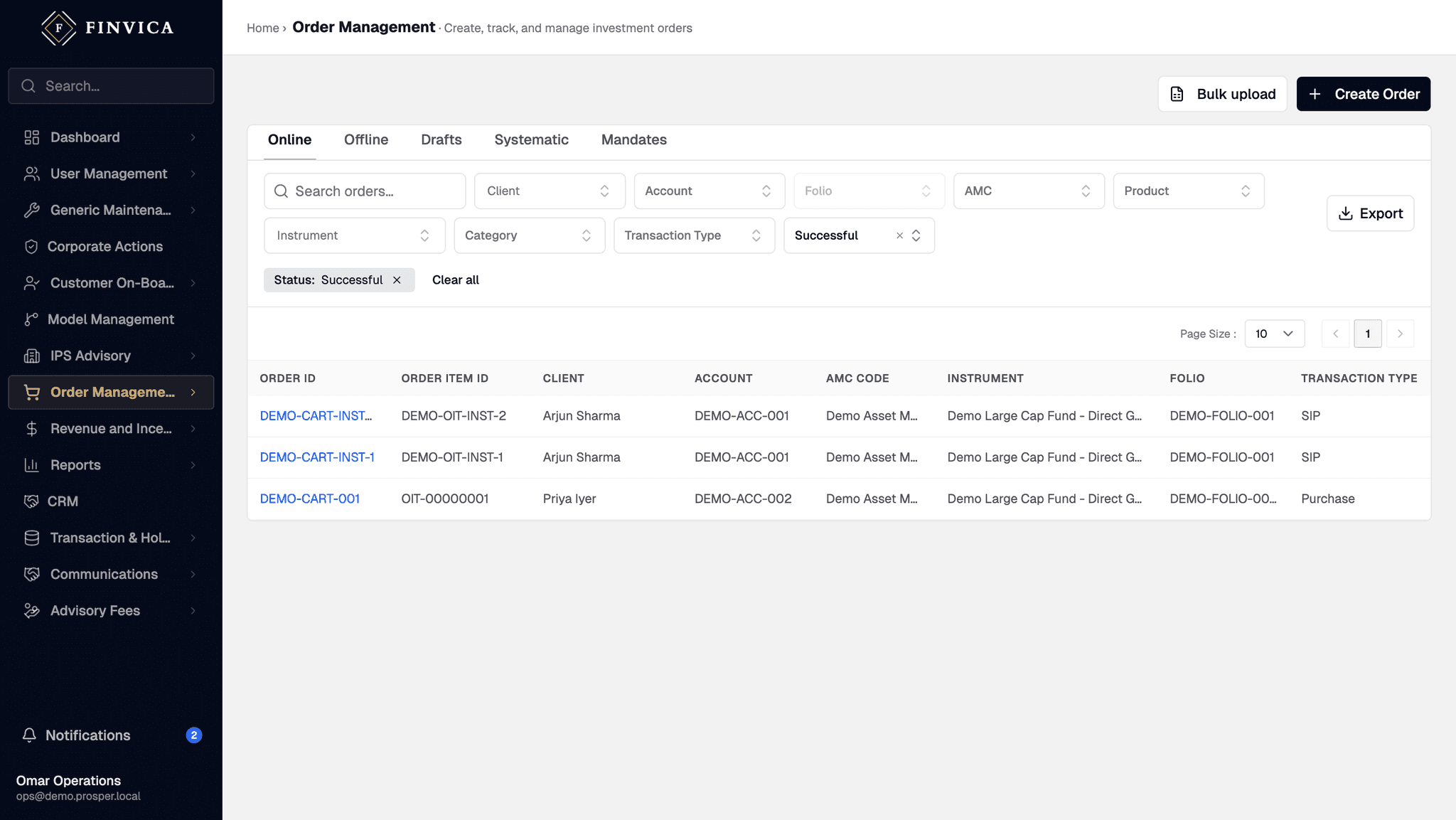
Purchases, redemptions, switches, SIPs and STPs are all first-class order types.
Orders route under your own exchange membership, not ours.
Classes with no exchange to route to are captured, and the platform says which is which.
Order status is tracked to settlement rather than ending at submission.
A rejected order carries the reason, not just the rejection.
On screen
Order management, as it ships.
Coverage
Which product classes this covers.
Exchange routing applies to mutual funds. Every other class is captured directly — the coverage matrix states which is which per class rather than implying uniform automation.
How it works
Three or four steps, in order.
Build the basket
One client, several classes, one submission.
Validation runs
EUIN, KYC status and mandate checks happen before anything leaves.
Route or capture
To the exchange where one exists; recorded directly where it does not.
Track to settlement
Status follows the order until units land in the book.
- BSE StarMF
What order management connects to
Questions about order management.
Can I place orders across classes in one go?
Yes — that is the module’s reason for existing. A mutual fund SIP and a bond purchase for the same client go in together rather than as two separate exercises.
What happens if an EUIN has expired?
The order is blocked at entry with the reason stated. Catching it here rather than at the AMC saves the two-day round trip and the awkward call.