
Module
Wealth CRM — The call you should make today, and why.
Without it
What this costs you today.
A generic CRM knows a client exists. It does not know their portfolio drifted, their KYC expires in three weeks, or that their SIP failed on Tuesday. So it tells you to call everyone equally, which is the same as telling you nothing.
What it does
Business rules, not adjectives.
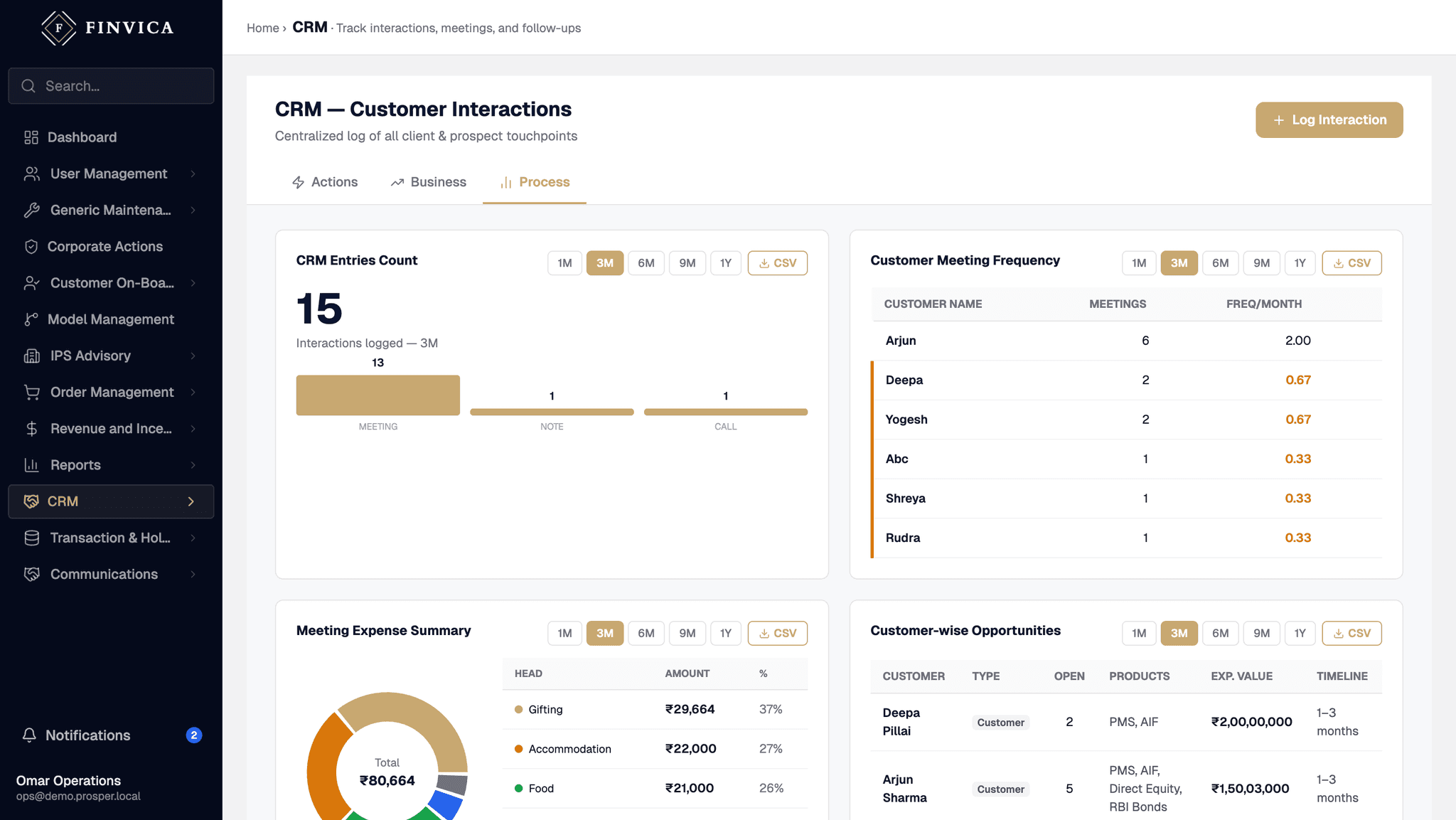
The client record holds the portfolio and the conversation, not one or the other.
Follow-ups are set against the client and surface on the day.
KYC expiries, failed mandates and pending confirmations raise themselves.
Interaction history is visible to whoever opens the record next.
Clients segment by what they hold rather than only by what they are worth.
On screen
Wealth CRM, as it ships.
Coverage
Which product classes this covers.
Every client on the book, across every product class they hold.
How it works
Three or four steps, in order.
The day opens with a list
What needs attention, ranked by why it matters.
The record carries context
Portfolio, history and open items in one place.
The follow-up is set
And surfaces when it is due, to whoever owns the relationship.
Questions about wealth crm.
Is this a general-purpose CRM?
No, and deliberately. It knows what a folio is, what an EUIN expiry means and what a failed mandate implies — a generic CRM knows none of that and cannot prioritise your day.