
For distribution houses
We run RMs, branches and sub-brokers — and reconcile all of it by hand.
Hierarchy, mapping and split commissions that settle themselves, so month end stops depending on one person and one spreadsheet.
The problem
What this looks like today.
- 01
Sub-broker splits live in a spreadsheet only one person can maintain.
- 02
Every branch reports differently, so the consolidated number takes a week.
- 03
An RM leaves and nobody is quite sure what they could see.
A day on the platform
What the work actually looks like.
Morning
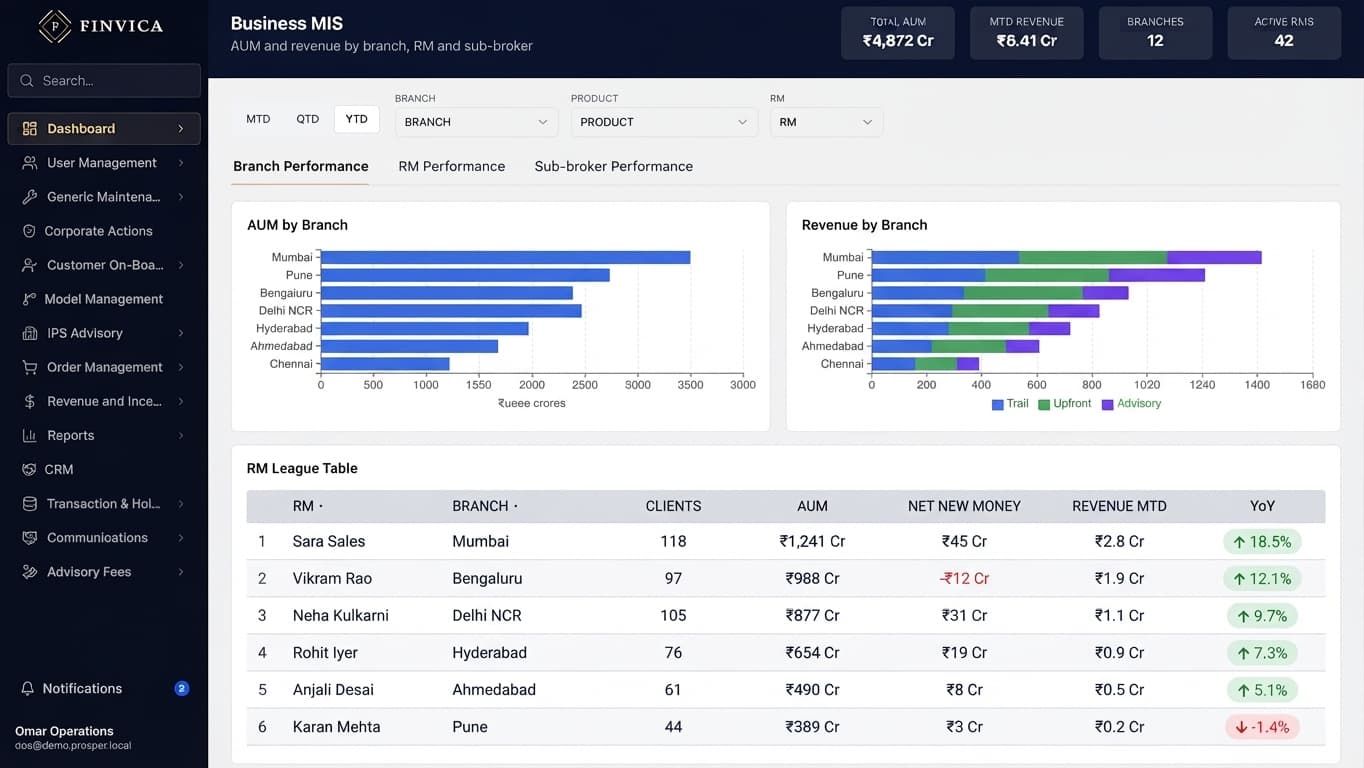
The whole house on one view.
AUM and revenue by branch, by RM and by sub-broker, from the same book rather than from four returns filed at different times.
Through the day
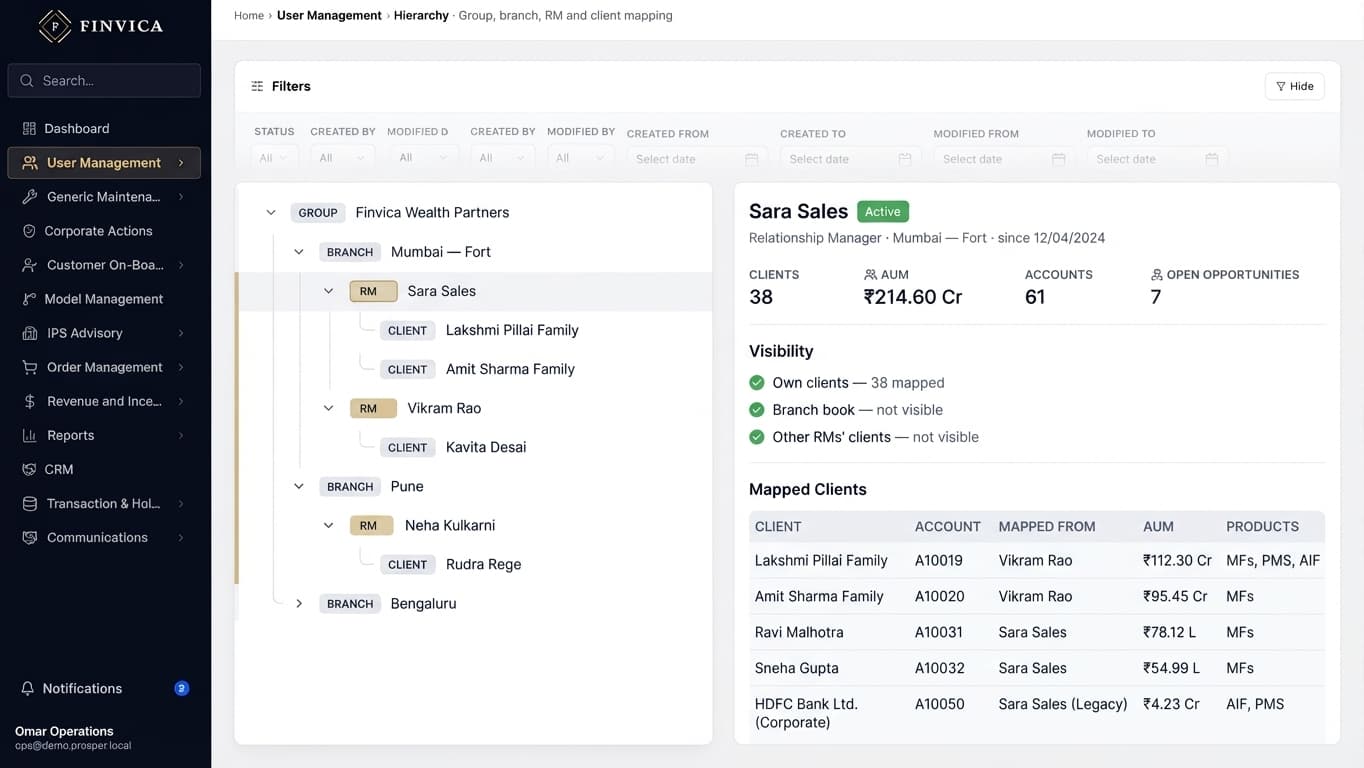
Everyone sees their own book, and only theirs.
An RM sees their clients, a branch head sees the branch, and the mapping that decides this is a configuration rather than an honour system.
Month end
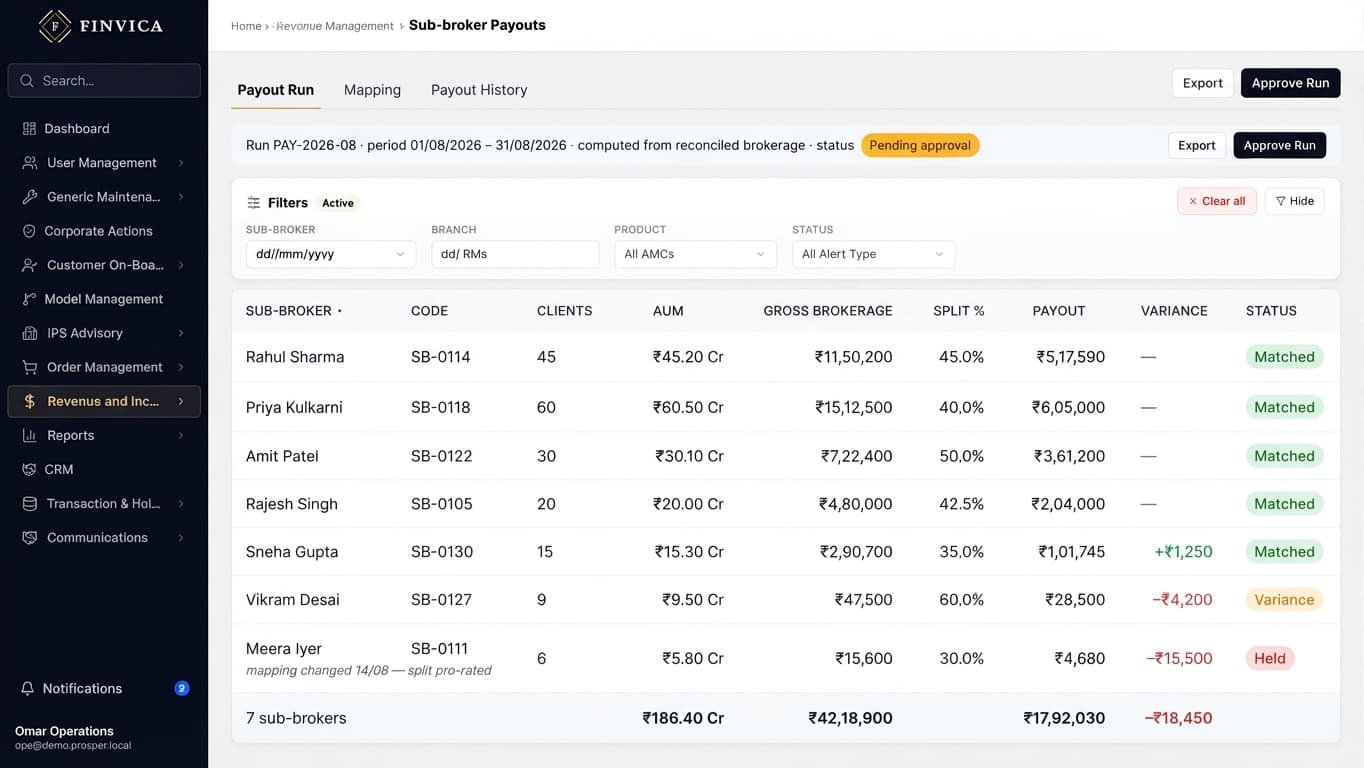
Splits compute with the brokerage, not after it.
Sub-broker shares apply on the rules you set, from the same reconciled figures as your own revenue. Nobody rebuilds the calculation.
The modules this buyer lives in.
Set up
Get the firm, its people and its clients onto the system.
Serve
Answer the client before they ask.
Grow
Get paid, and see where the practice is going.
Coverage
What is supported, class by class.
| Product | Order capture | Routing | Corporate actions | Valuation basis | Reporting | Commission |
|---|---|---|---|---|---|---|
| Mutual Funds | Yes, with conditionsOnline and offline | Yes, with conditionsBSE StarMF | Yes | Yes, with conditionsUnitised — units × NAV | Yes | Yes |
| AIF | Yes, with conditionsOffline order entry, with drawdowns | Not supported | Not supported | Yes, with conditionsNon-unitised — statement value | Yes | Yes |
| PMS | Yes, with conditionsOffline order entry | Not supported | Not supported | Yes, with conditionsNon-unitised — statement value | Yes | Yes |
| Bonds | Yes, with conditionsOffline order entry | Not supported | Yes, with conditionsVia bond settlement engine | Yes, with conditionsUnitised — units × price | Yes | Yes, with conditionsRate matrix and manual entry |
| Direct Equity | Yes, with conditionsOffline order entry | Not supported | Yes | Yes, with conditionsUnitised — units × price | Yes | Yes, with conditionsNot modelled — brokerage, not commission |
| Fixed Deposits | Yes, with conditionsTransaction / holding upload | Not supported | Not supported | Yes, with conditionsNon-unitised — statement value | Yes | Yes, with conditionsRate matrix and manual entry |
| Recurring Deposits | Yes, with conditionsTransaction / holding upload | Not supported | Not supported | Yes, with conditionsNon-unitised — statement value | Yes | Yes, with conditionsRate matrix and manual entry |
| NPS | Yes, with conditionsTransaction / holding upload | Not supported | Not supported | Yes, with conditionsSet per instrument | Yes | Yes, with conditionsRate matrix and manual entry |
| Insurance | Yes, with conditionsTransaction / holding upload | Not supported | Not supported | Yes, with conditionsSet per instrument | Yes | Yes, with conditionsRate matrix and manual entry |
| Real Estate | Yes, with conditionsTransaction / holding upload | Not supported | Not supported | Yes, with conditionsSet per instrument | Yes | Yes, with conditionsRate matrix and manual entry |
Mutual Funds, AIF, PMS, Bonds and Direct Equity carry a full product specification. The other five are basic information only by design — held, valued and reported, with no product-specific fields planned. Valuation basis is set per instrument rather than per product, and defaults to unitised. Non-unitised positions report at value with zero units.
How we charge — stated plainly.
- One per-firm subscription. Everything in one licence.
- The price never scales with your AUM.
- No revenue share. No basis points. Ever.
- The number is quoted on your demo — and it holds.
- Mutual Funds
- AIF
- PMS
- Bonds
- Fixed Deposits
- Direct Equity
- NPS
- Insurance
- BSE StarMF
- CAMS
- KFintech
- AMFI
- CVL KRA
Every product class, one book
What distribution houses ask.
How deep can the hierarchy go?
Four levels — group, family, client, account — and the organisational structure of branches and RMs maps onto it rather than sitting beside it.
Can sub-brokers log in?
Yes, scoped to exactly their own clients and nothing beyond.
What happens when an RM leaves?
Access ends with their directory account if you use your own identity provider. Their clients re-map to whoever takes over, and historical splits are not rewritten.
Do sub-brokers cost extra?
No. The subscription is per firm and does not change with how many sub-brokers you map.